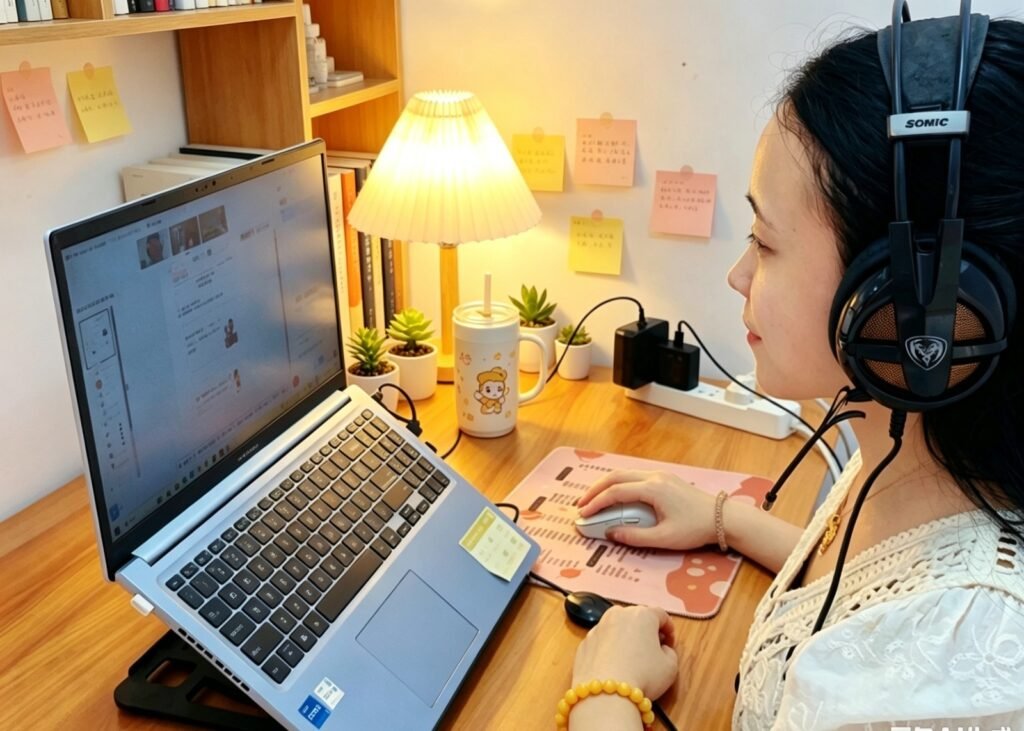
Today, Connected Learning is an online Chinese tuition centre teaching Primary and Secondary students across Singapore. Its classes are live, capped at four students, and built around the Singapore school syllabus. Parents receive a detailed report on their child’s progress every month.
But Winnie was never an educator. She did not set out to build a tuition centre.
She was a mother of four, trying to find the right help for four very different children.
The Question No Tuition Centre Could Answer
With four children at different school levels, Winnie’s weeks revolved around tuition. Different centres, different schedules, different drop-offs and pick-ups.
It was exhausting. But the travelling was not what bothered her most.
Despite all the time, money and effort, she was not convinced the lessons were working.
Each of her children struggled in a different way. One could not keep up when the lesson moved too quickly. Another understood the work but was too shy to speak up in a large class. The same classroom was failing them for completely different reasons.
Two Primary 5 students can sit in the same class with completely different levels of proficiency. One is bored. The other is lost.
So why were students grouped by age or school level, when their actual Chinese abilities could be worlds apart?
From Struggling Mum of Four to Mumpreneur
For a long time, Winnie kept searching for a tuition centre in Singapore that could answer that question. None could.
She had never thought of becoming an entrepreneur. But the longer she searched, the clearer it became that the solution she wanted did not exist.
“Instead of continuing to search for the right solution, perhaps I could create one.”
In May 2015, she started Connected Learning. Every part of it came from something she had watched her own children go through.
Classes would be small, so no child could hide or fall behind. Students would be grouped by their actual ability, not their school level. Lessons would be live and interactive with stories and games, not just a teacher talking on a screen. And parents would finally be able to see what was happening in their child’s learning.
“In a sense, I built the tuition model I had been searching for as a parent.”
Selling Online Chinese Tuition When No Parent Trusted It
There was one problem. In 2015, almost nobody in Singapore trusted online tuition.
This was five years before Covid-19 pushed every classroom onto a screen. To most parents, learning Chinese online sounded like a compromise. Something you settled for, not something you chose.
Winnie could not argue parents out of that belief. So she did not try.
Instead, she focused on what she could control. She kept classes small. She found Chinese teachers who could genuinely engage children online, through stories, games and constant interaction. She followed the Singapore syllabus closely. And she kept talking to parents.
The goal was simple: make the programme so good that parents could see the value for themselves.
Slowly, they did. One good experience led to another. Parent feedback began to do the convincing that no marketing could.
And Winnie noticed something about why families stayed.
“Parents weren’t choosing us simply because they didn’t have to travel. They were choosing us because their children could receive structured Chinese support in an environment where they felt comfortable participating.”
Convenience got parents through the door. The teaching kept them there.
Why Small Group Chinese Tuition Works When Big Classes Don’t
There is no shortage of Chinese tuition in Singapore. What Winnie found missing was a model built around the individual child.
In a large class, a quiet child can go an entire lesson without saying a word. In a class of four, every child has to respond, and every child gets noticed.
Grouping by ability means a stronger student is no longer held back, and a struggling one is no longer left behind. Lessons move at the pace the group actually needs.
Rote learning has turned many children off Chinese for good. So Connected Learning’s teachers use stories and games to keep students involved. The aim is not just better grades, but a child who stops dreading the subject.
And every month, parents receive a detailed update on their child’s progress. It is the visibility Winnie never had when she was the parent waiting outside a tuition centre.
For the busy working parents who make up most of Connected Learning’s families, that combination matters. They want convenience, but never at the expense of teaching quality.
The Lesson Winnie Carries
More than a decade after she started, Winnie still runs Connected Learning the way she would want it run for her own children.
Her four children taught her that there is no single type of struggling student. That lesson became the foundation of everything she built.
“Instead of asking children to adapt to the tuition system, I wanted to create a system that could better adapt to the child.”
For Winnie, success is not measured by grades alone.
“Grades matter, of course, but when a child who used to avoid Chinese starts participating, speaking up or approaching the subject with less fear, that is meaningful progress too.”
She did not become a mumpreneur in Singapore for the money. She became one because she was a parent who stopped waiting for someone else to fix her problem.
If you are looking for Chinese tuition that adapts to your child, you can find out more about Connected Learning’s classes on their official website here.